Repair when the damage is isolated, the roof still has meaningful service life left, and the layer that actually keeps water out is intact. Replace when damage is widespread, the roof has reached the end of its material's expected life, or you are paying for the same problem more than once. In Arizona there's a third question most homeowners never think to ask: on a tile roof, is the tile worn out, or is the underlayment underneath it?
Your roof protects you from weather effects and unwanted intrusion from wildlife and people. Eventually, it will wear out and show signs of wear and degradation. The tricky part is deciding whether to repair or replace your roof. Knowing how to weigh differences can help you avoid wasting money and prevent issues from escalating further.
When is a simple repair enough?
If your roof has minor damage, like a few missing shingles or a small leak, repairing it may be the best option. These problems are typically isolated and can be handled quickly without disrupting the entire structure. For example, if a recent windstorm tore off a couple of shingles or you notice a minor leak around a vent, a qualified roofer can patch it up without needing to redo the whole roof. Repairs are usually cost-effective and can extend your roof's lifespan if handled promptly.
In practice, these are the situations where a repair is almost always the right call:
- A handful of tiles cracked or slipped by foot traffic — solar installers, HVAC techs and satellite crews break tile constantly
- Failed sealant or a deteriorated pipe boot, which UV chews through faster than almost any other component
- A section of edge metal or flashing lifted by a monsoon microburst
- One localized leak on a roof that is otherwise well within its service life
- A foam roof that needs recoating rather than replacing — manufacturers generally expect a recoat on roughly a 10- to 15-year cycle, and staying on that schedule is maintenance, not failure
The common thread: the problem has a boundary. You can point to where it starts and where it stops.
What signs point to a full replacement?
However, not all roof damage can be resolved with a quick fix. If your roof is older—say 20 years or more—it might be time to consider a full replacement. It's even more recommended if it's showing signs of widespread wear. One indication that you need a new roof is consistent leaking in multiple areas. The recurring water damage suggests the system is failing even after previous repairs.
Add these to the list:
- Leaks in unrelated locations. One leak is an event. Three leaks in three different parts of the roof is a system telling you it's finished.
- Deck damage. Soft or spongy decking, or visible sagging between rafters, means water has been getting in for a while.
- Brittle, cracking underlayment visible when tile is lifted. If it crumbles when you touch it, patching around it buys months, not years.
- Widespread granule loss and curling across a shingle roof, not just on one exposure.
- Repeat repairs in the same place. If you've fixed it twice and it's back, the diagnosis was probably "the system," not "the spot."
Repair or replace: how the factors line up
| Factor | Points toward repair | Points toward replacement |
|---|---|---|
| Roof age vs. material life | Well within expected range | At or past expected range |
| Extent of damage | Localized, defined boundary | Widespread across multiple slopes |
| Leak history | First or second isolated leak | Recurring leaks in different areas |
| Deck condition | Sound throughout | Soft spots, sagging, rot |
| Underlayment (tile roofs) | Pliable, intact | Brittle, cracked, disintegrating |
| Repair history | None or minimal | Repeated repairs to the same system |
| How long you'll own it | Selling soon or short horizon | Long-term hold |
| Energy performance | Acceptable | Poor; attic runs extremely hot |
If most of your answers land in the right-hand column, the math has already decided for you.
How does your roof's material and age change the answer?
Every material has a different clock, and Arizona's heat and UV push most roofs toward the shorter end of national ranges.
The National Association of Home Builders' life-expectancy work is the most-cited baseline: asphalt roofs around 20 years, wood shake around 30, and slate, copper and clay or concrete tile over 50. Manufacturer ranges for low-slope systems land at roughly 15 to 25 years for TPO and 20 to 30 for EPDM, while spray polyurethane foam can run far longer provided its topcoat is renewed on schedule.
The tile exception every Arizona homeowner should understand
Tile is where the standard advice breaks down. Concrete and clay tiles routinely outlive the underlayment beneath them by two or three decades. Organic felt underlayment typically goes brittle somewhere in the 12 to 20 year range in desert attic temperatures; high-temperature synthetic and modified bitumen products carry longer manufacturer ranges.
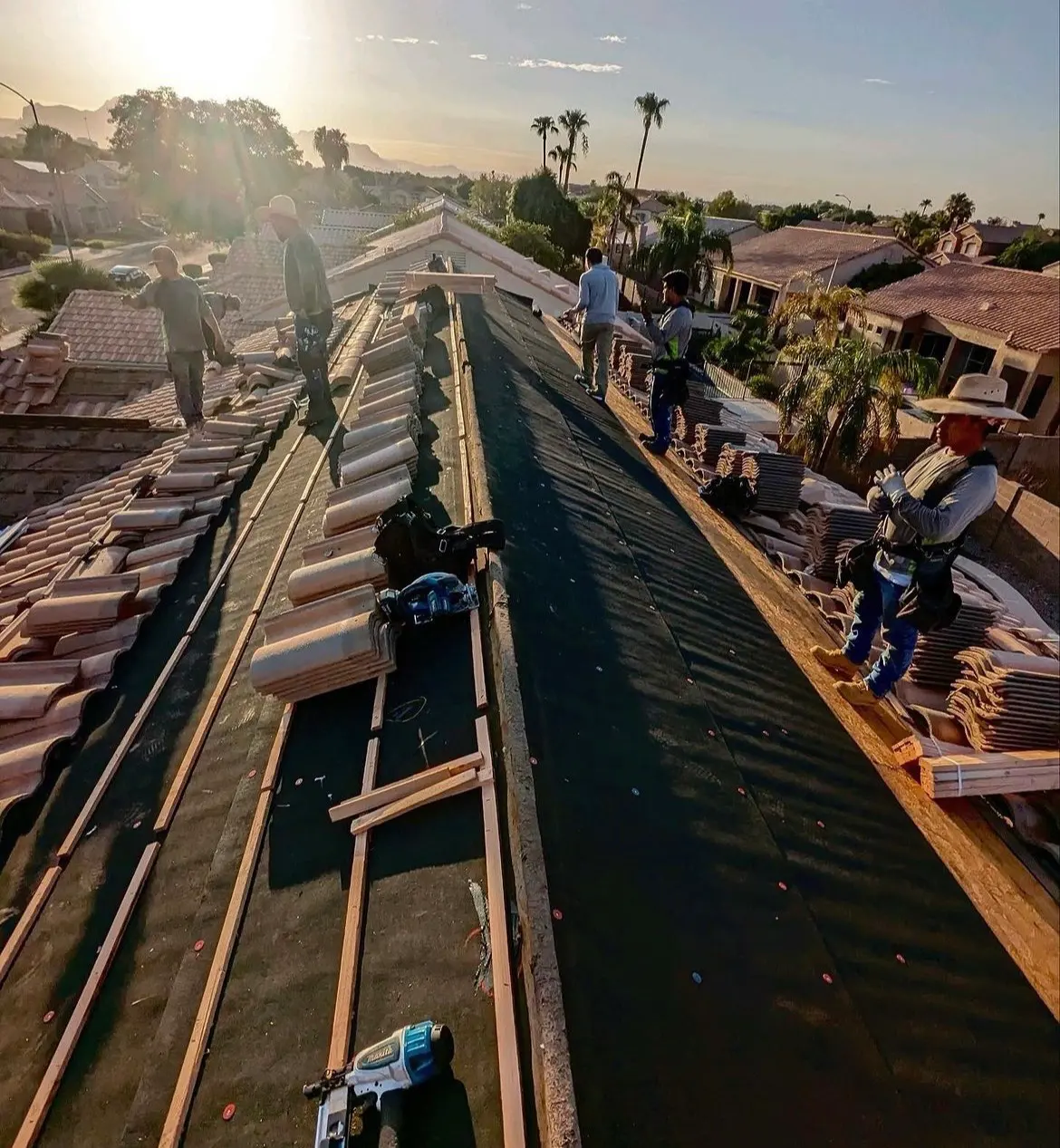
So a 20-year-old tile roof that's starting to leak generally does not need new tile. It needs a lift and re-lay — stack the existing tile, strip and replace the underlayment, repair any damaged decking, reset the same tile. That is a replacement of the waterproofing system while reusing the covering, and it's one of the most common jobs we do on residential roofing throughout Gilbert, Mesa and Chandler.
Does building code ever force a full replacement?
Yes, and it's worth knowing before someone offers to lay new material over your old roof.
The International Residential Code, Section R908.3.1.1, does not permit a roof recover where:
- The existing roof already has two or more applications of any type of roof covering
- The existing roof or covering is water-soaked, or deteriorated to the point that it can't serve as an adequate base
- The existing covering is slate, clay, cement or asbestos-cement tile
In those cases the existing material has to come off down to the deck. A contractor who tells you otherwise is either not pulling a permit or not reading the code. Tearing off also has a practical benefit: it's the only way anyone can actually see the condition of your decking.
How should you weigh long-term costs?
Another factor to consider is the cost over time. Constant repairs can ramp up your expenses more than a replacement can. Getting a new roof is still costly upfront. However, it does offer peace of mind, better energy efficiency, and increased home value. You should also consider the materials used for your roof. A replacement is a safer bet if they have reached the end of their expected lifespan.
Two things belong in that calculation that most people leave out:
Cost per year of service. A repair that buys two years on a failing roof costs far more per year than a replacement that delivers twenty. Divide the price by the years it realistically adds and compare honestly.
The energy side. A reroof is the cheapest moment you will ever have to fix ventilation and insulation, because the deck is exposed and the attic is accessible. The Department of Energy notes that a conventional roof can reach 150°F or more on a sunny summer afternoon while a reflective roof under the same conditions can stay more than 50°F cooler, and DOE guidance for climate zone 2 — which covers Phoenix metro — calls for attic insulation in the R-30 to R-60 range. The International Residential Code also sets attic ventilation at a minimum net free ventilating area of 1/150 of the vented space, with a 1/300 allowance when 40 to 50 percent of the required venting sits high in the attic and the rest sits low. Doing that work during a reroof costs a fraction of doing it as a separate project later.
What about storm damage?
The National Weather Service defines the Arizona monsoon as June 15 through September 30, and the microbursts and haboobs inside that window are what generate most sudden roof damage in the Valley. After a storm, the sequence matters:
- Look from the ground first. Displaced tile, torn edge metal, debris on the roof, granules in the gutters.
- Check the ceilings and attic for fresh staining or damp insulation.
- Get a professional inspection with a written, photographed report before you commit to anything. Dated documentation is what supports an insurance conversation and what tells you whether you're looking at a repair or a system failure.
- Don't sign with a door-knocker. Verify any contractor's license through the Arizona Registrar of Contractors before work begins.
Regular roof repair and maintenance visits before and after monsoon season are the cheapest insurance available, and they're what keep small problems in the repair column instead of the replacement column.
Protect your roof and investment today
Paying attention to the early signs of damage and acting accordingly can avoid costly surprises and ensure you stay safe and comfortable. An experienced roofer at Eco Roofing Solutions, LLC in Arizona, can assess the damage and recommend the most cost-effective solutions.
We're a family-owned contractor based at 75 W Baseline Rd Suite 19 in Gilbert, licensed under Arizona ROC 330901 (CR-42) and a member of the Arizona Roofing Contractors Association. Owner and President Eric Perry is a third-generation roofer with over 25 years of hands-on experience, and he'd rather tell you your roof has ten good years left than sell you one you don't need.
See our full range of services, or contact our team at (480) 695-7736 to have someone walk your roof and give you a straight answer.