Flat roofs are a good fit in Arizona more often than in most of the country, because the failure mode they are most vulnerable to, standing water, is the thing our climate produces least. A properly sloped, properly drained low-slope roof gives you cheaper material coverage, usable rooftop space, and safer access for maintenance. The catch is that it demands drainage discipline and regular inspection, and it does not forgive neglect the way a steep tile roof will.
Flat roofs are prevalent in residential and commercial buildings, especially in warmer climates. But is this roofing option the best choice for your home?
What is a flat roof, really?
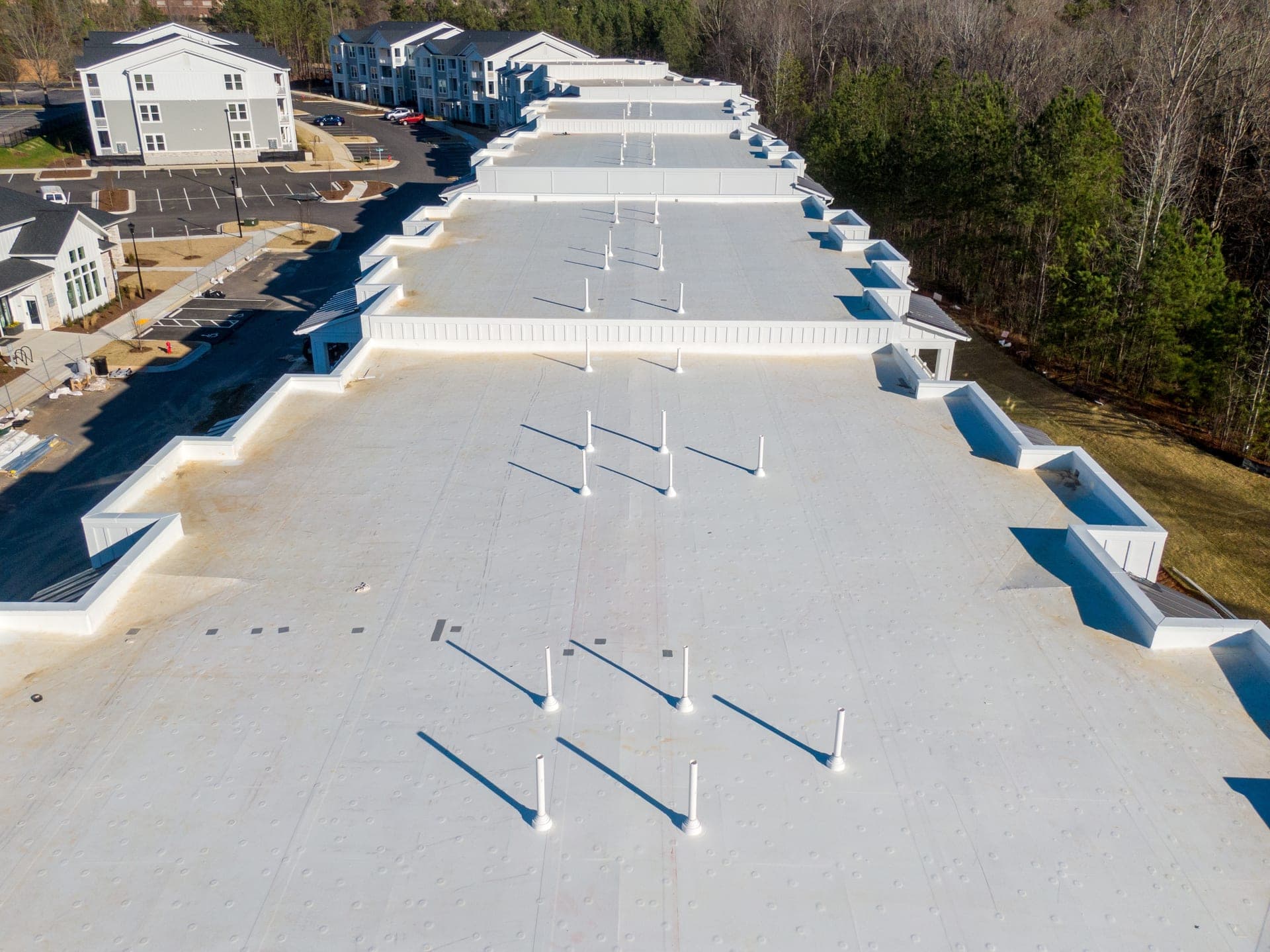
Flat roofs are not entirely flat but have a slight slope for water drainage. They are typical in urban areas and are made from materials such as PVC, bitumen, and rubber.
"Low-slope" is the more accurate industry term. The National Roofing Contractors Association recommends a minimum of 1/4 inch of slope per foot on low-slope roofs, and that same figure shows up in many manufacturer warranty requirements. That slope can come from the structure itself, from tapered insulation built up on the deck, or from crickets steering water around curbs and equipment. On a roof that reads as dead flat from the street, there is usually a deliberate drainage plan underneath.
Why are flat roofs so common in Arizona?
Two reasons. First, architecture: Southwest and mid-century desert design leaned hard on horizontal rooflines and parapets, and the look never went out of style here. Second, climate. The Phoenix metro sits in the hot-dry climate zone 2B, with no snow load to speak of and long stretches with no precipitation at all. A roof style that struggles with sustained water and snow accumulation in Ohio has a much easier life in Gilbert.
That said, our rain arrives in bursts. According to the National Weather Service, Arizona's monsoon season runs June 15 through September 30, and much of the year's rainfall falls in a handful of intense storms. A low-slope roof here is not asked to handle constant water. It is asked to move a lot of water very fast, a few times a year.
What are the benefits of a flat roof?
Keeping yourself informed about the advantages will help you make the right decision. Here are several benefits of using a flat roof for your property:
Cost-effective
One of the biggest draws of a flat roof is its affordability. Flat roofs require fewer materials than traditional pitched roofs, making them budget-friendly. Additionally, installation is faster and easier, reducing labor costs. There is less surface area to cover than on a pitched roof spanning the same footprint, and there is no framing complexity for hips, valleys, and dormers.
Versatile use of space
Flat roofs provide additional usable space. Many homeowners use them as outdoor patios, gardens, or solar panel platforms. This versatility is especially valuable in city homes with limited yard space, offering a creative way to make the most of your roof. On commercial buildings, that same space is where the HVAC equipment, exhaust fans, and condensers live, which is a big part of why low-slope construction dominates retail, industrial, and multifamily buildings.
Easier access
Unlike steeply pitched roofs, flat roofs are much easier and safer to access for inspections, repairs, or routine maintenance. Whether you need to clean gutters or check for leaks, navigating a flat roof is much simpler than climbing a sloped one. In practice this changes the economics of maintenance: inspections are quicker, so they actually get done, and small problems get caught while they are still small.
What are the drawbacks of a flat roof?
While flat roofs have unique benefits, there are some disadvantages that you need to be aware of. These drawbacks include the following:
Potential for water pooling
Since flat roofs have a shallow slope, they can sometimes need help with water drainage. If not adequately managed, standing water can lead to roof damage or leaks over time. This is primarily a concern in areas with heavy rain or snowfall, or in higher-elevation Arizona towns like Flagstaff, Prescott, and Payson where snow load is a genuine design factor.
The industry benchmark is worth memorizing: the NRCA treats water that remains on a roof more than 48 hours after a rain, under conditions favorable to drying, as ponding. Ponding adds dead load, accelerates membrane degradation, concentrates dirt and debris, and is excluded from many manufacturer warranties. Here in the Valley, ponded water also evaporates and leaves behind a mineral and dust residue that marks exactly where your drainage problem lives, which is a useful diagnostic if you know to look for it.
Shorter lifespan
Flat roofs generally last shorter than pitched roofs. Most flat roofs last 10 to 20 years, depending on the materials and maintenance. Pitched roofs, however, can last 20 to 30 years or more. Modern single-ply systems have pushed the upper end of that range out considerably, but the underlying point stands: a low-slope roof has seams and penetrations, and seams and penetrations are where roofs fail.
Temperature fluctuations
Flat roofs can absorb more heat, especially in hotter climates. Without proper insulation, this can make your home warmer in summer. A dark low-slope roof takes the full brunt of overhead sun for the entire middle of the day, with no pitch to shed the angle. The EPA reports that conventional roofs in the United States can reach summer peak surface temperatures of 150 to 185 degrees Fahrenheit, while cool roofing products can stay roughly 50 to 60 degrees cooler. On a flat roof, that is not just an energy issue; it is the thermal cycling that fatigues seams year after year. This is why reflective membranes and coatings are close to standard practice on low-slope roofs in the desert.
Which flat roof material should you choose?
| System | Typical service life | Strengths | Watch for |
|---|---|---|---|
| TPO (thermoplastic polyolefin) | Commonly 20 to 30 years | Heat-welded seams, white reflective surface, widely available | Seam quality depends heavily on installer skill |
| PVC | Commonly 20 to 30 years, longer when fully adhered | Heat-welded seams, strong chemical and grease resistance | Higher material cost than TPO |
| EPDM (rubber) | Often 25 to 40 years by thickness and attachment | Proven longevity, handles movement well | Black membrane absorbs heat unless a coated or ballasted assembly is used |
| Modified bitumen / built-up | Varies widely by ply count and surfacing | Redundant layers, tough underfoot | Heavier; darker surfacing needs a reflective cap or coating |
| Spray polyurethane foam | Long service life with scheduled recoats, typically every 10 to 15 years | Seamless, self-flashing around penetrations, roughly R-6.5 per inch | Requires recoating discipline; sensitive to installation conditions |
| Reflective restoration coating | Varies by system and thickness | Extends a sound roof, raises reflectance, no tear-off | Only valid on a dry, sound, well-drained substrate |
There is no universally correct answer in that table. The right pick depends on the deck, the existing insulation, rooftop equipment, chemical exposure, foot traffic, and how long you intend to hold the building. Our commercial roofing team specs these systems for warehouses, retail centers, and multifamily properties around the Valley, and we spec them differently for a residential patio deck.
How do flat roofs handle monsoon storms?
This is the real Arizona test. The National Weather Service tracks a monsoon season from June 15 to September 30, and its signature events, microbursts and haboobs, hit roofs in different ways.
- Wind uplift. Microburst outflow winds can be violent and highly localized. Low-slope roofs fail at the perimeter and corners first, where uplift pressures are highest. Edge metal, terminations, and fastening patterns matter more than the field of the roof.
- Debris impact. Wind-driven gravel, palm fronds, and loose equipment panels puncture membranes. A single small puncture over a seam can soak an entire insulation bay.
- Dust loading. Haboob dust settles into drains, scuppers, gutters, and low spots. Blocked drainage is the most common preventable cause of ponding we see after monsoon season.
- Volume, fast. An inch of rain in twenty minutes tests every drain, overflow scupper, and flashing detail you have.
Ninety percent of monsoon damage prevention is unglamorous: clear the drains, verify the edge metal, check the penetration flashings, and replace failed sealant before June. A scheduled commercial roof maintenance visit covers all four.
What maintenance does a flat roof need in the desert?
- Two inspections a year at minimum, ideally before mid-June and again in October.
- Keep drains, scuppers, and overflows clear. Dust and debris are the enemy of drainage here.
- Walk pads under traffic routes. Anywhere an HVAC tech goes monthly needs protection.
- Check every penetration. Curbs, vents, skylights, conduit, and equipment supports are the usual leak origins.
- Document ponding after storms. Take a photo 48 hours out. If water is still there, you have a slope or drain problem, not a membrane problem.
- Recoat on schedule if you have a foam or coated system. Deferring a recoat is how a repairable roof becomes a replacement.
So, is a flat roof right for you?
Flat roofs have many advantages, including affordability, versatility, and easier maintenance. However, they also have potential downsides, like water pooling, shorter lifespan, and temperature challenges. A flat roof design in Arizona could be a great choice due to the dry, warm climate, giving you extra space for a garden or solar panels. On the other hand, if you face heavy rainfall or snow, consider the additional maintenance a flat roof requires.
A flat roof tends to make sense when you want rooftop equipment or usable space, when the building's architecture calls for it, when you value low-cost access for inspections, and when you are prepared to actually maintain it. It makes less sense when nobody will be responsible for checking the drains, or when the existing structure cannot be given proper slope without significant work.
If you want to know the best roofing for your building, contact us today at Eco Roofing Solutions, LLC. We are a family-owned, ARCA-member contractor licensed under Arizona ROC 330901 (CR-42), and we provide roofing solutions for homes and businesses across the Valley, including commercial work in Mesa and residential low-slope sections throughout the East Valley. Tell us what your roof is doing and we will tell you honestly whether it needs repair, restoration, or replacement.